ARE CLOUDS (part 1)
Wilhelm Reich, Jacques Lacan, war treaties and wardrobe choices
Over the course of my childhood, my mother constructed hundreds of orgone generators. For a while, we even had a copper pyramid-shaped orgone accumulator you could sit inside and a contraption she called a Hail Mary, which I remember as two pipes and a hose in a white bucket with something to hold them in place. I'm assuming you have no idea what I'm talking about, so let's get into a readily accessible layer of it.1
Depending on who you ask, the devices my mother made either A) accumulated a universal life force discovered by psychoanalyst Wilhelm Reich, or B) are outsider objet d'art. The Hail Mary device was like a tiny cloudbuster2 intended to influence weather patterns. As a child, I accepted this as routine. I myself regularly attempted to negotiate with clouds.
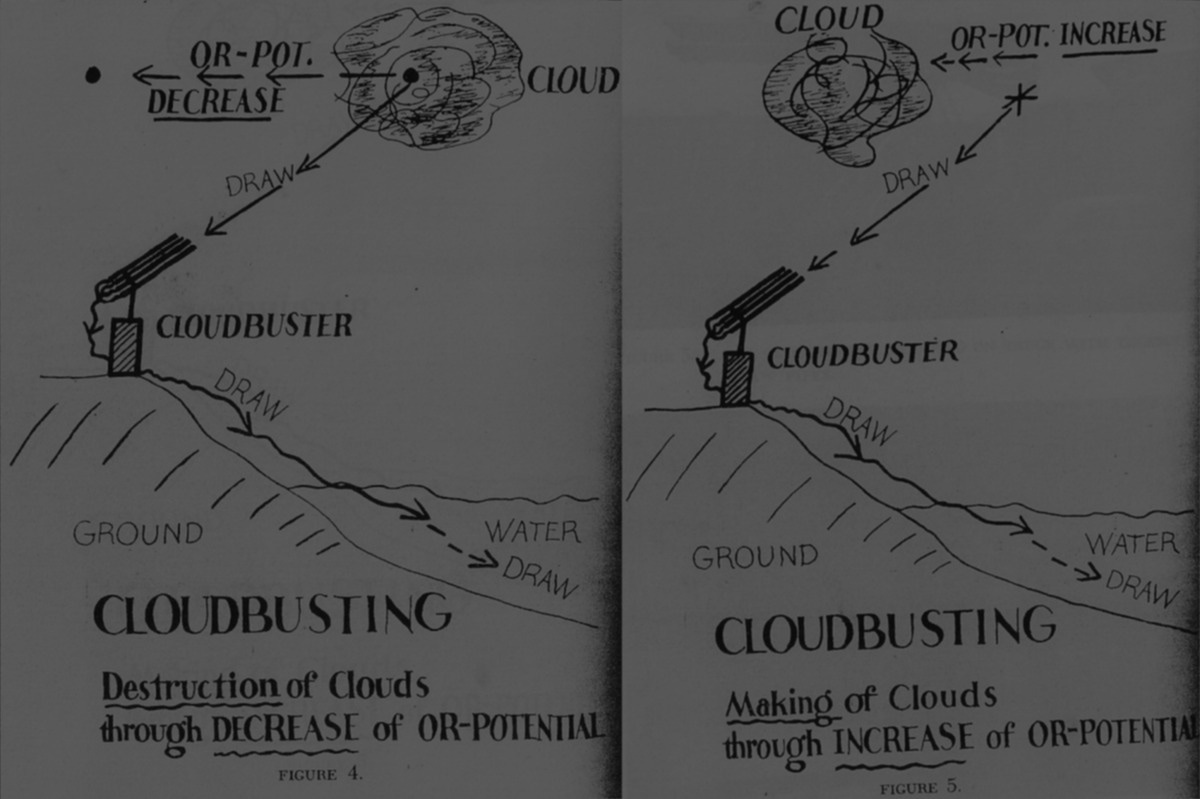
There’s quite a bit of negotiation when it comes to the weather. Mystical pleas for rainmaking methods range from getting cats wet to those regular ol’ rain prayers, from imitative magic rites to romantic frog matrimony. Oh, and then there’s a version where one buries children up to their necks in the ground, in hopes the gods will be sympathetic and drop a few tears.3 And on and on and on. Turns out bargains with the sky are commonplace, but how do we gauge the power of devotion on moisture?
Now that I no longer enjoy the childhood indulgence of accepting phenomenal premises as everyone's everyday experiences, I'm less concerned with whether the cloudbusters worked than with how natural it is that we would want to alter the skies in the first place.
Our relationship to clouds is peculiar. We want them to depict or reveal something, to rain or to stop raining. We want them to evolve, to move, to shift. We pretty much want them to do something different from whatever they're doing. Lacan called it objet petit a, the unreachable thing that organises wanting. The cloud is a good stand-in for want itself.
Then there are the sayings: They had a cloud hanging over them. His judgment was clouded. Her head was in the clouds. Even granting that every cloud has a silver lining, that assumes the cloud itself is the unfortunate part. Looks an awful lot to me like sunshine is sitting pretty in polaraized sunglasses, enjoying a remarkably successful reputation, meanwhile the smear campaign on clouds associates them with confusion and obstruction. I’m conflicted and feel defensive of clouds. It’s a lot to be a human who stares at the sky.
Clouds are often framed as interruptions to what is running smoothly, like some sort of damp saboteur. As though this whole apparatus would function better without them.

It could be that what bothers us is not the cloud itself but our inability to see through it, the opaqueness blocking the direction of our gaze. We want to trust what we see, and when our vision is obscured, literally or figuratively, it’s destabilising. If only we could believe, could own what we see.
The trouble is that the cloud doesn't just block the view; it interrupts the fantasy that seeing guarantees knowledge. And once that fantasy fails to steady us, the reach for control is usually next. The history of cloud-watching appears to split in two directions: divination or dun, dun, domination.
Ofc, the urge to possess a piece of the sky didn’t start or end with Wilhelm Reich. Countless earlier accounts of vapour barons can be found, and here’s a good one from 1916. In an attempt to end a drought, the San Diego City Council hired this guy, Charles Hatfield, a self-described "moisture accelerator". They paid him zilch up front and got a fatal flood in return. When Hatfield came to collect his fee, the city refused, given that paying him out would have meant admitting the flood was their fault. There were suits and countersuits until eventually a judge ruled the rain an act of God, which meant nobody got paid since nobody was liable.
There are plenty of funded efforts to revise the weather, as governments monitor and increasingly try to engineer the clouds. And because humans are assholes who will go to war with whatever is at hand, this 1977 treaty deemed it necessary to explicitly prohibit nations from using “environmental modification techniques” as weapons. Not as a hypothetical concern, mind you, but something specific enough to require its own international agreement.

Ok. Back to me, me, me. I remember being told that there was no bad weather, just bad clothing for the weather. It’s served me well in life to dress for what the skies dictate. I dont always get it right, but it’s a twist to know that when the weather arrives, I would ask how to improve it.
The naughty cloud appears, and we ask how to make it behave. But there’s something uniquely and deeply human in this impulse. We encounter uncertainty and immediately begin imagining how it might be managed.
Dogen and other Zen teachers offer a different association altogether, suggesting rain and clouds as metaphors for thoughts, feelings, and shifts in circumstances. Lots of let it pass, observe it, do not cling to the cloud cos the cloud is not the problem. It’s getting awfully wet out there, so yeah, you could just chill, and let yourself get soaked. I guess.
I can aaalmost get behind the zen version. It feels practical and relieves me of the responsibility that comes with the fantasy of control. Little cloudy thinklings arise and disperse in the vastness of sky. Still, there’s this odd unwantedness.
In these metaphors, clouds occupy the objectionable role of obstacle, considered useful because it’s an (impermanent) blockage to the expansive sky. The cloud exists to teach us something about what passes if we're patient, good little watchers. There is still this allusion to the pure, unblemished sky as the goal. Why must the cloud always be redeemed by disappearance? Why is its value so often contingent on passing?
So it’s back to the mystical for me.

Creators of religious and sacred art imagined something else: in piece after piece, clouds function not as obstacles but as thresholds. Deities arrive through them. Angels with harps and horns stand upon them. Blessed saints and Falkor and miracles emerge from them.
Clouds become watery membranes between worlds, neither entirely earthly nor entirely divine. The clouds aren't boundaries or barriers. The clouds are interfaces.
In part deux of this essay, I’ll write about what passes through them and to where.
If you want to go deep into what it’s like to be raised by Reichians, that’ll be a different format; I’m partial to in-person conversations
Yes, the Reichs were the inspiration for that Kate Bush banger
https://en.wikisource.org/wiki/Page%3AThe_Golden_Bough_(1922).djvu/95
So good. We're cloudbusting Daddy!