ARE CLOUDS (part 2)
Anne Carson, Georgia O’Keeffe, a space cam girl
And now we continue. I've decided, for now, that clouds are not boundaries or barriers but interfaces, watery membranes between worlds. Artists have been peering into and attempting to capturing that threshold for centuries, looking upward.
One of the best ever to do it looks back down. It’s classicist Anne Carson come correct with the best aesthetic and her beautiful tangled, vulnerable and dry sense of humor. Carson is extravagantly skilled, generous in how she spends it. And I'm bringing her into this because it's mine, and I can do whatever I want with words in defense of clouds.
If you don’t watch the clip, I’ll spoil. In Lecture & Performance on the History of Skywriting, Carson executes a subtle and delightful maneuver: she begins as herself, as writer, as the sky observing the cloud, then stops reporting about the cloud and begins writing from it. No longer an object of observation, cloud becomes perspective. Carson interrupts the habit of looking upward for answers by asking what it is the sky has been learning from us. I’ll get back to this after more words.
If humanity’s first runs at deciphering clouds were attempts to enter into relation with what couldn't be explained, over time, we chugged along beyond meaning-making, beyond relation, and in our growthy-scaley-manifest destiny way, accelerated into attempts to control the clouds. With it the weather, prophecies, each other, the future.
No longer was honoring and bargaining with the gods enough. We wanted to enlist the sky to achieve our dastardly aims. Stronger than devotion may be the urge of life to accumulate. So when that divine threshold closed, we built a new one. In Lacan’s terms, when one object no longer organizes desire, we construct another and call it the same thing. The object changes, but the lack remains.
So we constructed an entirely new Cloud with a capital C. It’s presumably the most successful metaphorical trick of the modern era, tho it does have competition. (We invented a term for statistical pattern-matching models and called it intelligence, and now that too is rapidly accumulating in the atmosphere.)
The word cloud suggests something above us, floating and weightless1 and diffuse. Something untethered from terrestrial geography and material constraints. Just calmly passing through. In reality, we all know the Cloud is astonishingly physical, taking the form of server farms in squat warehouses the size of small towns, guzzling energy from electrical grids, sucking at undersea cable teats, gagging on enormous quantities of water and rare earth minerals. Choose the Form of the Destructor, a la Gozer the Gozerian.
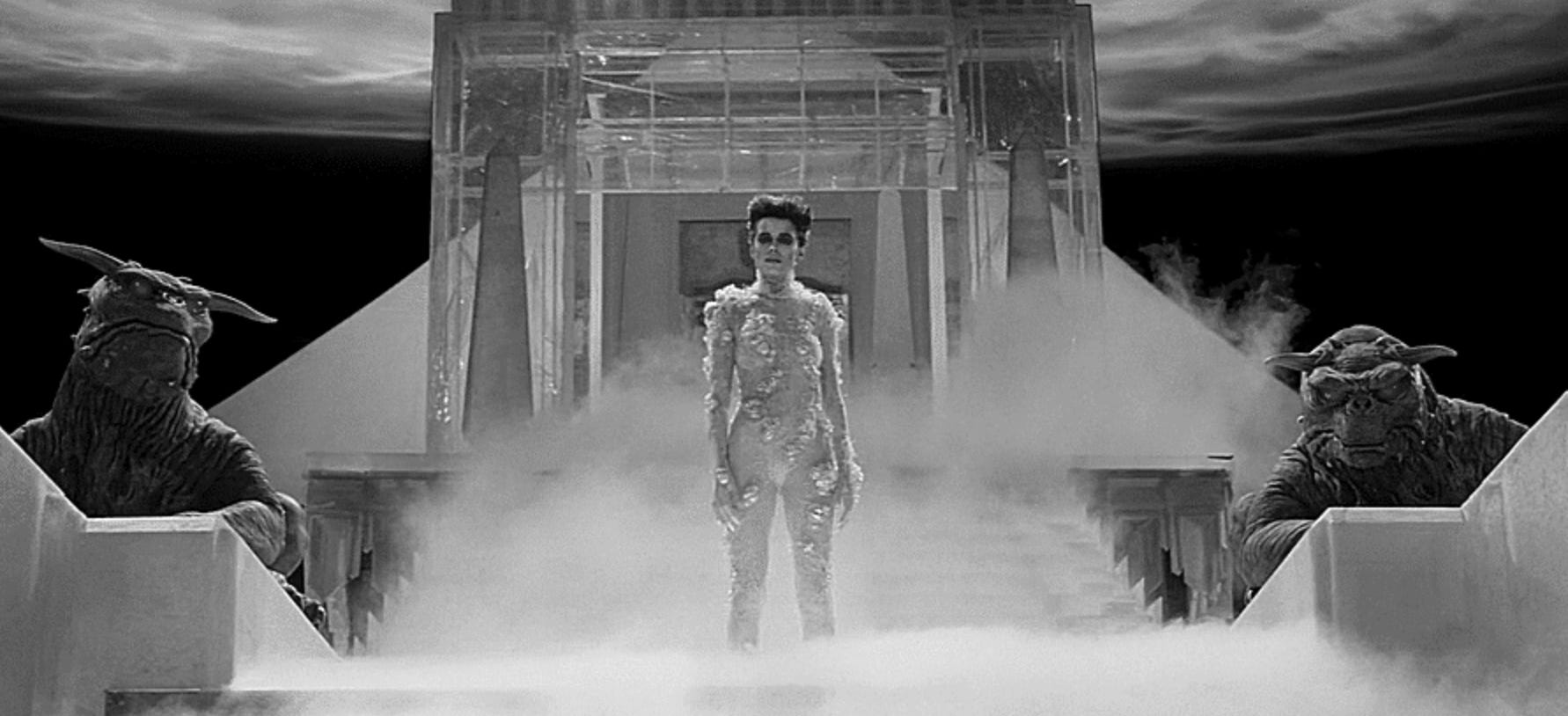
Clouds have always functioned as projection surfaces. With that in mind, ones growing archives of dick pics and message data are par for the course. We deposit our concerns in these repositories for whatever we can't quite hold or digest, and the Cloud collects the projections of what we can't explain or contain. Every age seems to require a cloud capacious enough to hold its anxieties. And lo the clouds grow more and more opaque.2
Makes it all the more fitting that actual clouds are recording us. If you think I miswrote that, you underestimate the weirdness of actuality. Aerosols from human residue, smoke, and emissions, seed their formation, alter their density and life cycle. Climate scientists observe shifts in cloud formation and link those changes to pollution as well as warming temperatures.3 We have changed the conditions under which clouds form. This isn’t some kind of metaphor, gd this is real! The clouds remember what we release into them, not only what we project.
They are accumulators forming assemblages of strange, magical archives written in water. All these bits of us floating up into temporary collaborations. Even light leaves a record.
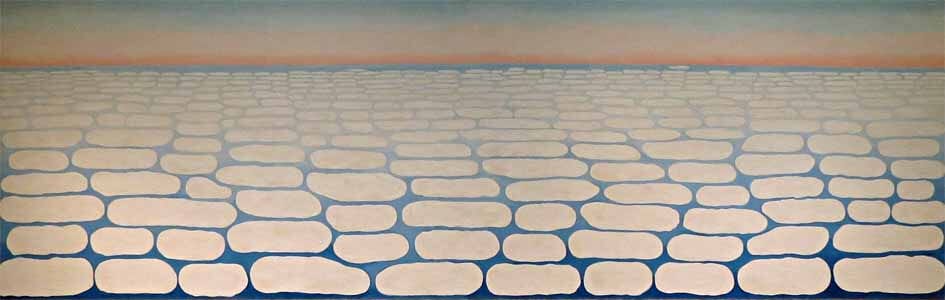
You ever hear of… Georgia O’Keeffe? Yeah, lots of subtly suggestive blooms and sensual landscapes, and then theres her eleven-painting cloudscape series, Sky Above Clouds. O’Keeffe took her first airplane flight in her late seventies, and looking down from overhead, she saw clouds from a new angle. Inspired, she painted immense, white dotted fields stretching toward new horizons in an almost immersive form. Sky Above Clouds IV is a full 24 feet long and 8 feet high. This new perspective was physically too large to fit through the doors at museums. Imagine yourself as her seeing the hazy whipped tops of clouds for the first time at 77 and feeling, knowing you were going to transmit that.4
Seen from overhead, clouds are no longer weather; they become the terrain.
When we fly over or emerge from the clouds in our miraculous flying metal birds, the clouds aren’t the ones shifting. A horizon can be less a limit and more the shifting edge of your current vantage point.
The problem might not be that clouds obscure our vision or our compulsion to control them. It might be that we have spent far too long believing we are underneath, when all along, just like putting on rain gear for wet weather, another way of relating was available. O'Keeffe recognized she was seeing the clouds differently than she had. No need to correct or avoid, control or ignore them. She acknowleged the new perspective and made something so large you could stand inside it. She wasn’t painting an interruption but a new vocabulary. Maybe it has a word like skyography in it.
I like to be generous. It doesn’t always suit me, but it feels good when I can afford it. And if I’m feeling generous, my mother’s orgone generators and mini cloudbusters could be viewed as early lessons in the art of participation: weather not as backdrop, but relation. Light as something that moves through, not something that stays.
There’s my Phipps Pt. song, Roomy Ajar, that grew from a Rumi poem: “Pale sunlight / Pale the wall / Love will come / The light changes / I need more grace than I thought.” Like the cloud cover or wide open space of sky, grace won’t arrive because the wall changed.
I was laying in my garden today, staring up as a form in the sky morphed. I hope we can change. And I hope we can watch the people we love change in real time.
xo, <3
But, not really, at all: https://www.usgs.gov/water-science-school/science/how-much-does-a-cloud-weigh
Lacan complicates vision: the trouble is never simply that we cannot see through the cloud, but that the cloud interrupts the fantasy that seeing guarantees knowledge. Worse, it raises a possibility that something opaque may be looking back. Sowwy. This is just how my brain works
I remember an amendment to playing lava as a child was… acid rain! Although I think it might have been invented as a justification for pushing each other off of whatever we perilously balanced on to avoid the lava
Heard a story that, despite the fairly direct title, some viewers mistook the clouds for icebergs. I can’t find a source tho. There’s also a story that she told people she was nearly blind during the construction of this painting.
So good! ☁️☁️🌩️☁️☁️